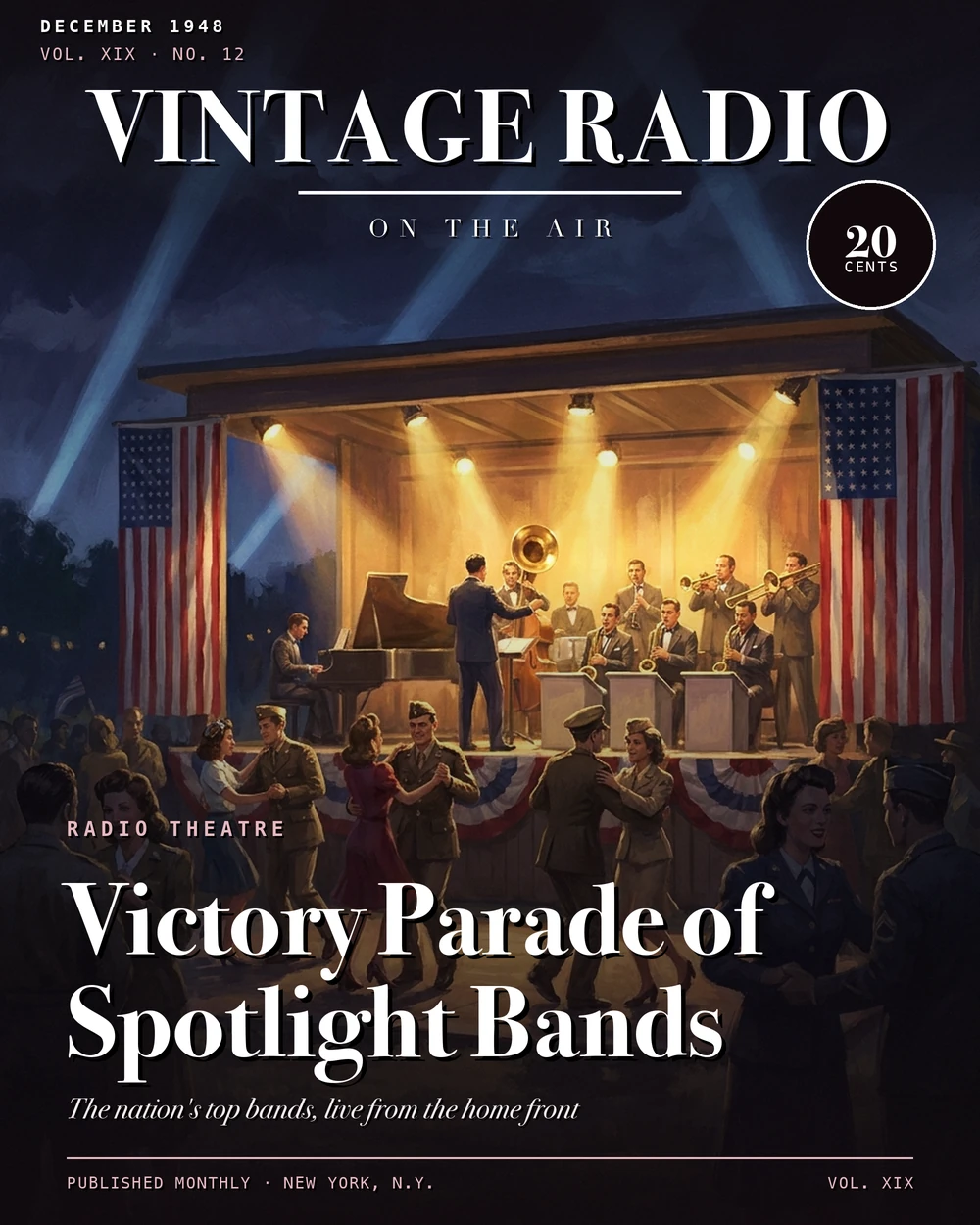
Victory Parade of Spotlight Bands
How It Came to Life
The idea started with a Coke and a competition. In 1941, Coca-Cola's longtime advertising agency, D'Arcy Advertising, dreamed up a nightly showdown for the nation's big bands — each orchestra vying for a weekly "Silver Platter Award" based on record sales. The first broadcast went out on November 3, 1941, on the Mutual Broadcasting System, airing Monday through Friday in a tight 15-minute window from 10:15 to 10:30 p.m. Eastern. A different name band appeared each night. Kay Kyser's orchestra led off the very first week, followed by Guy Lombardo, Sammy Kaye, Tommy Dorsey, and Eddy Duchin. The first Silver Platter went to Freddy Martin for his recording of "Tchaikovsky's Piano Concerto," released under the popular title "Tonight We Love."
That competitive format didn't survive long. The first edition aired just days before the Japanese attack on Pearl Harbor on December 7, 1941, which meant the show was essentially a wartime program from its earliest weeks. Once the United States entered the war, Coca-Cola and D'Arcy scrapped the Silver Platter competition entirely and shifted the show's purpose toward something bigger — bringing live music directly to the people the war was most disrupting.
The Wartime Format That Defined the Show
The real identity of Victory Parade of Spotlight Bands took shape on September 21, 1942, when Coca-Cola moved the program from Mutual to the Blue Network. The Blue Network had superior facilities for remote pickups from locations scattered across the country, which was exactly what the new format demanded. The show expanded to 25-minute weeknight broadcasts at 9:30 to 9:55 p.m. Eastern War Time, and the title became "The Victory Parade of Spotlight Bands." The show now traveled — to military bases, veterans' hospitals, and defense plants — bringing orchestras to the workers and service members who couldn't easily get to a ballroom.
Every broadcast opened the same way: a bugle calling assembly, then a roll call of the band leader, the band itself, and finally the men and women of whatever military facility or plant was hosting that night. All Coca-Cola-sponsored broadcasts were introduced by an instrumental melody called "The Coca-Cola Company Theme," composed by conductor and arranger Leonard Joy. The final five minutes rotated through a series of different talents over the run: blackface comedy duo Molasses & January (Pick Malone and Pat Pagett) in the early going, then British singer Gracie Fields from October 1942, motivational speaker Dale Carnegie from January 1943, and singer Grace Morgan from April 1943.
The Armed Forces Radio Service transcribed the first 15 minutes of music from each broadcast and rebroadcast those recordings to Allied servicemen around the world — extending the show's reach far beyond what any domestic radio signal could manage.
The Bands That Played
During the Silver Platter period, the competition produced some memorable streaks. Harry James and vocalist Helen Forrest won the award for seven consecutive weeks for "I Don't Want to Walk Without You." Tommy Dorsey and a young Frank Sinatra took it five straight weeks for "This Love of Mine." Those early weeks gave the program some of its most talked-about moments before the format gave way to the remote broadcast model.
Once the show settled into its wartime identity, the roster of orchestras became a who's who of American big band music. Among the acts documented on the program: Benny Goodman, Charlie Barnet, Guy Lombardo, Bob Crosby, Jack Teagarden, Louis Armstrong, Lawrence Welk, Sammy Kaye, Lionel Hampton, Artie Shaw, Duke Ellington, Xavier Cugat, Louie Prima, Buddy Rich, Glenn Miller, and the Andrews Sisters, who appeared frequently throughout the run. Andy Kirk, Henry King, Bob Chester, Ina Ray Hutton, Charlie Spivak, Johnny Long, Ted Fio Rito, Gene Krupa, and Les Brown all made appearances as well — Brown returning for at least two separate episodes.
The sheer variety of the lineup was part of what made the show work. Swing, jazz, dance band, novelty — the program moved across styles as easily as it moved across geography.
The Christmas Marathon and Other Milestones
On Christmas Day, 1942, the program staged something it called "Victory Parade's Christmas Party of Spotlight Bands" — an all-day marathon broadcast on the Blue Network that was picked up by more than 142 radio stations. At the time, it was reportedly the longest commercially sponsored broadcast in radio history. That single day captures what the show had become by its second year: something large enough to command a national audience and important enough that stations across the country wanted to carry it.
The Blue Network run from September 1942 through June 16, 1945 — nearly three years of six-nights-a-week broadcasting — is considered the show's prime. Over the full span from November 1941 through November 1946, the program broadcast more than 1,200 episodes, making it one of the longest-running prime-time big band showcases in network radio history.
The Wind-Down
When the war in Europe ended and the Pacific followed in the summer of 1945, the show began to change. The move back to Mutual came on June 18, 1945 — the Blue Network's conversion to ABC had created obstacles to renewing the Coca-Cola contract, and Mutual took the show back. On August 20, 1945, the "Victory Parade" branding was dropped and the program reverted to its original Spotlight Bands title.
Coca-Cola's sponsorship ended on November 22, 1946, five years and change after that first Mutual broadcast. The stated reason was a sugar shortage that had curtailed soft-drink production. The U.S. Army briefly stepped in as a nominal sponsor to keep the show going a few more weeks, but the run concluded on December 2, 1946, with a final performance by Guy Lombardo — who had also appeared in the very first week back in November 1941.
What Survives
Around 217 episodes are known to survive in the catalog, weighted toward the 1942–1945 Blue Network period when the show was at its most active. Big band historian Karl Pearson later compiled 25 broadcasts from that prime stretch into a CD collection, accompanied by a 28-page program guide — a sign of how seriously researchers and enthusiasts have continued to regard the show's historical value.
The format was simple: live bands, live audiences, live rooms in places people were stationed or working during the worst years of the war. There was no elaborate dramatic structure, no serial storyline, no star comedian carrying the load. The music was the show, night after night, traveling to wherever people needed it most.